

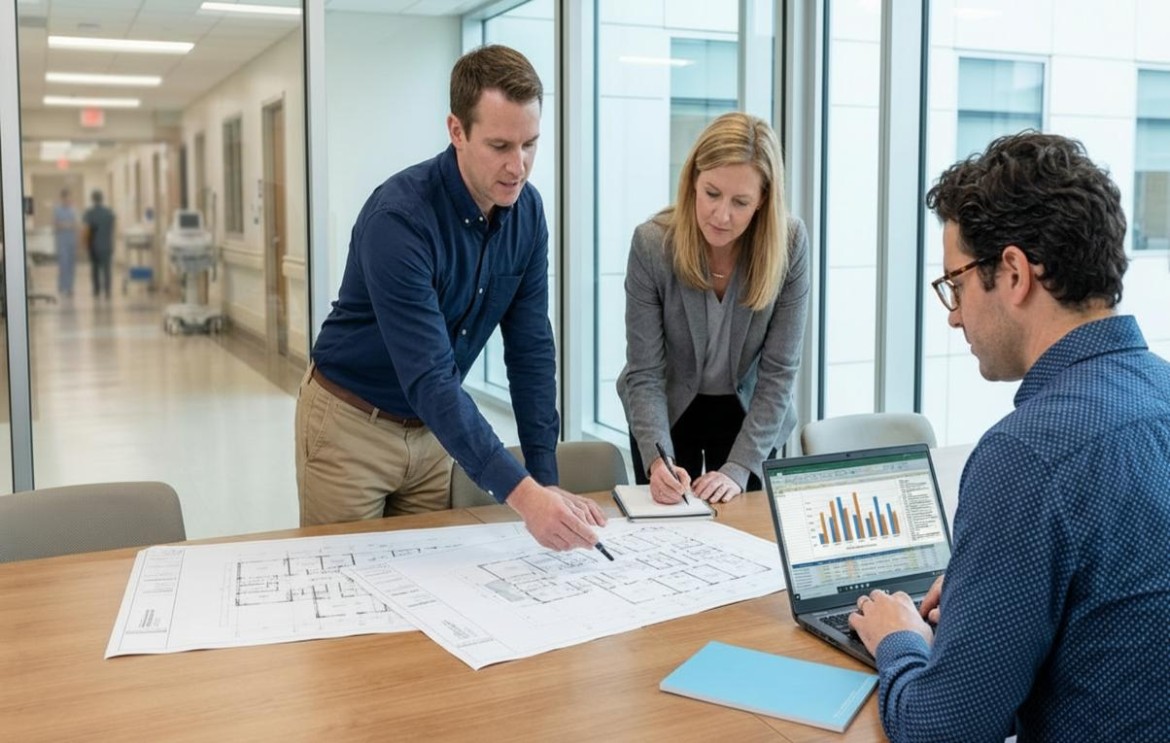
Healthcare construction costs in occupied facilities go beyond labor and materials. Owners also have to account for infection control, phased work, temporary systems, shutdown coordination, and the fact that patient care must continue throughout construction.
That is why budgeting works best when it starts early and includes a team that understands active healthcare environments, like Vertix Builders.
Key Cost Drivers in Occupied Healthcare Renovations
Occupied healthcare renovations create cost pressures that standard commercial projects often do not. The project team has to protect patients, support staff, and keep essential systems running while work moves forward.
Infection Control Requirements Drive Specialized Costs
Infection control is a major cost driver, not a minor line item. The CDC’s environmental infection control guidance supports using an infection-control risk assessment before work that may create dust or water aerosols.
In practice, that can mean temporary barriers, negative air machines, HEPA filtration, dust-control procedures, enhanced cleaning, and monitoring. These measures are essential, but they also affect the budget and sequencing.
Phasing and After-Hours Work Increase Labor and Schedule Pressure
Most hospitals cannot release an entire area for construction at once. Work is often phased around patient flow, staff access, and department schedules, with some tasks shifted to nights or weekends.
The Joint Commission requires a pre-construction risk assessment that addresses issues such as infection control, utilities, noise, vibration, and air quality. Those safeguards protect care, but they can extend schedules and increase labor costs.
Coordination with Clinical Teams and Building Systems Affects Cost Certainty
Occupied renovations require constant coordination with clinical leaders, facilities teams, and support departments. Utility shutdowns, equipment moves, access routes, and temporary life safety measures all have to be planned around patient care. When that coordination starts late, projects are more likely to face delays and change orders. When it starts early, costs become more predictable. Projects like the Sky Ridge Medical Center reflect how disciplined planning supports both operations and scheduling.
Strategies to Control Costs and Minimize Disruption During Renovations
Controlling costs in an occupied healthcare facility depends on early planning, clear visibility into healthcare-specific conditions, and construction strategies that reduce disruption before it affects staff or patients.
-
Start with strong preconstruction planning. Early collaboration with hospital leadership, infection prevention teams, facilities staff, and end users helps define phasing, shutdown windows, and mitigation plans before work begins. The ASHE ICRA 2.0 process gives teams a framework for aligning safety measures with construction execution.
-
Use prefabrication where it makes sense. Moving portions of work off-site can reduce jobsite congestion, support cleaner conditions, speed installation, and improve cost certainty.
-
Track healthcare-specific costs early. Owners should be able to see how barriers, filtration, swing space, shutdown planning, and off-hours work are affecting the budget so the team can make decisions before issues escalate.
Healthcare Construction Costs: Frequently Asked Questions (FAQs)
Facility directors often have to balance budget control with patient safety, compliance, and daily operations. These questions come up often during planning.
How do I estimate renovation costs for occupied hospital spaces?
Start with the base construction scope, then add healthcare-specific conditions such as infection control measures, phased access, temporary barriers, negative air, shutdown planning, swing space, and off-hours labor. An experienced healthcare contractor can identify these requirements early.
What strategies help control costs while minimizing disruption to patient care?
Early phasing decisions, detailed shutdown planning, and close coordination with department leaders are usually the biggest cost savers. Prefabrication, just-in-time delivery, and clearly defined work windows can also reduce disruption.
Which contingencies should I include for active medical environments?
Include contingencies for infection control measures, temporary utilities, access restrictions, escalation, and unforeseen operational constraints. In occupied healthcare work, contingency planning should reflect risk exposure, not just completeness.
How do hospital timeline constraints affect overall project costs?
Restricted work hours and phased turnover can increase labor and duration, but they may still be the right choice if they reduce disruption to patient care. The goal is a schedule that protects operations while staying financially manageable.
What role does early collaboration play in cost control?
It reduces uncertainty. When facilities, clinical teams, infection prevention, and the builder align early, the team can resolve access, utility, and safety issues before they become delays or redesign.
Choose a Partner Who Understands Occupied Healthcare Construction
Healthcare construction costs are easier to manage when your builder understands how to work in active medical environments. Vertix Builders helps owners plan smarter, phase work responsibly, and reduce disruption without losing sight of schedule, compliance, or patient safety.
If you are preparing for a renovation or expansion in an occupied facility, contact Vertix Builders to start the preconstruction conversation early.