

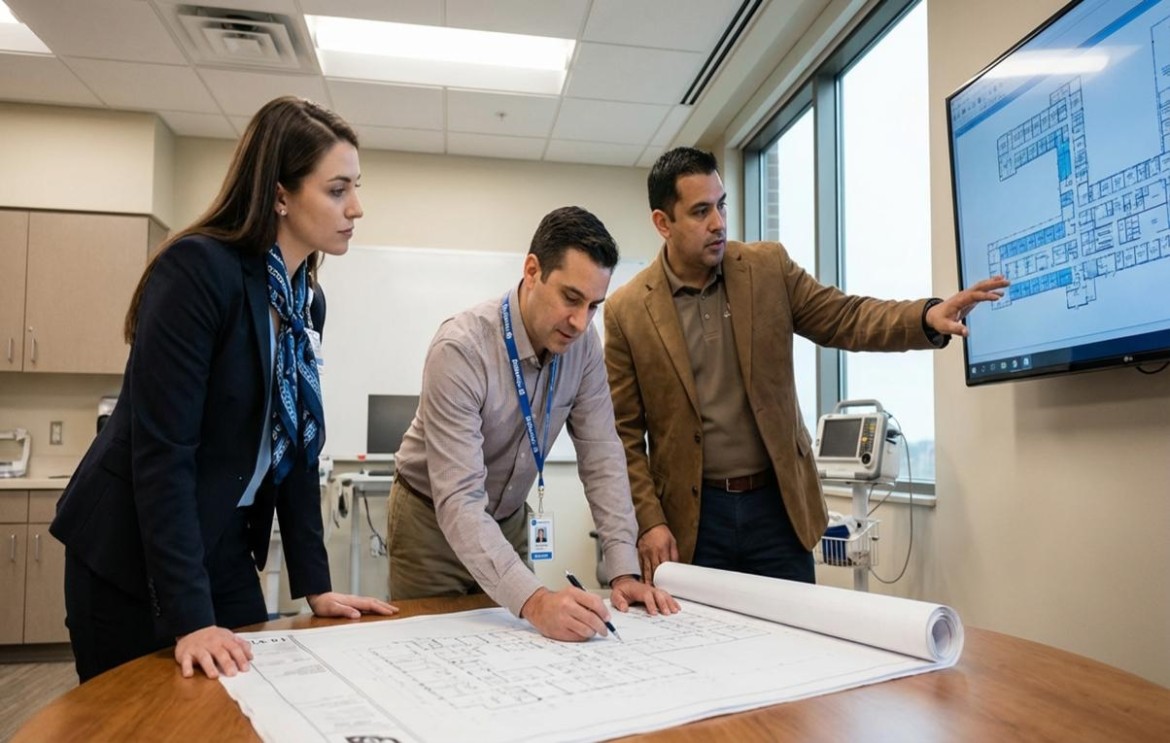
Smart hospital construction only works when technology supports care delivery instead of competing with it. That means aligning clinical workflows, digital priorities, and facility planning early.
Vertix Builders helps healthcare teams manage that process through ground-up construction built around operational clarity, coordination, and long-term performance.
From Vision to Reality: The Smart Hospital Construction Process
Traditional hospital projects often treat technology as a later add-on. Smart hospital construction requires a more integrated approach. From day one, healthcare leaders need to connect patient care goals with infrastructure, building systems, and activation planning.
Strategy and Scope: Define Your Clinical Foundation
Start by aligning operations, clinical leadership, IT, facilities, and construction teams early. Focus the conversation on:
Priority use cases such as patient monitoring, telehealth, RTLS, and nurse communication
Space, power, and data requirements tied to those use cases
Workflow issues that could create friction after opening
This early coordination helps prevent a building that looks right on paper but works poorly in practice.
Design and Integration: Engineer Your Digital Backbone
Once priorities are clear, the next step is building the infrastructure around them. That usually includes:
Fiber pathways and equipment rooms
Strong wireless coverage
Resilient power and backup planning
Coordination between MEP systems and clinical technology
An interoperability strategy for building, security, communications, and care systems
Interoperability planning, including FHIR standards and the USCDI framework, can help teams plan for long-term flexibility.
Build, Test, and Activate: Validate Before Go-Live
Construction is only part of the job. Before opening, teams should validate how the hospital will function in real operating conditions.
That typically includes:
Equipment coordination
Systems commissioning
Staff readiness and training
Mock rooms and scenario-based testing
Phased activation planning
AHRQ PSNet coverage of simulation and commissioning highlights the value of testing new healthcare environments before go-live.
This level of coordination is especially important on complex healthcare projects where multiple systems and stakeholders must come together on schedule.
Digital Infrastructure for New Smart Hospital Builds
Digital infrastructure should be planned as part of the building, not layered on at the end.
Core priorities usually include:
Backbone capacity for fiber, Wi-Fi, security, automation, and clinical devices
Sufficient electrical support and equipment space
Redundancy planning for critical systems
Pathways for future expansion
Clear ownership across clinical technology, cybersecurity, and facilities teams
For builders, the job is not just installing components. It is coordinating design, trades, vendors, and sequencing so the infrastructure performs as expected on day one.
Smart Hospital Construction: Frequently Asked Questions (FAQs)
Ground-up smart hospital construction gives healthcare teams the chance to align advanced systems with clinical operations from the start. Below are some of the most common questions leaders ask during planning.
How does smart hospital construction improve patient safety during ground-up projects?
It allows teams to build safety-supporting systems into the facility from the beginning. That can include better visibility, communication tools, monitoring infrastructure, and tested workflows. Early planning and pre-occupancy validation help reduce risk before patient care starts.
What digital infrastructure is essential for new smart hospital builds?
Most projects need a converged network, strong wireless coverage, resilient power, secure equipment spaces, and room for future expansion. Interoperability planning is also essential so clinical and building systems can exchange information reliably.
How can healthcare teams collaborate effectively during smart hospital construction?
Bring clinical, IT, facilities, and construction stakeholders together early and keep them aligned through design, procurement, and activation. Mock-ups, milestone reviews, and clear decision ownership help prevent late changes.
What regulatory standards must smart hospitals meet during construction?
Requirements vary by jurisdiction and project type, but teams commonly work through FGI guidance, local codes, accreditation expectations, life safety requirements, and healthcare-specific operational standards. Smart systems may also introduce cybersecurity and data governance considerations.
How do you manage smart hospital construction timelines and budgets?
Define the core use cases early, coordinate infrastructure decisions during design, and leave enough time for commissioning and activation. Projects usually run into trouble when technology scope is added too late or not fully coordinated across trades.
Build a Future-Ready Hospital with a Clear Step-by-Step Plan
Smart hospital construction succeeds when the plan is clear before the build accelerates. Start with clinical priorities, design the infrastructure around those needs, and test the environment before opening.
Vertix Builders helps healthcare organizations move from concept to completion with a practical, coordinated approach to ground-up building construction, complex healthcare projects, and transparent delivery. For leaders planning a future-ready facility, the right partner does more than build the shell. They help make sure the hospital works the way your team needs it to.