

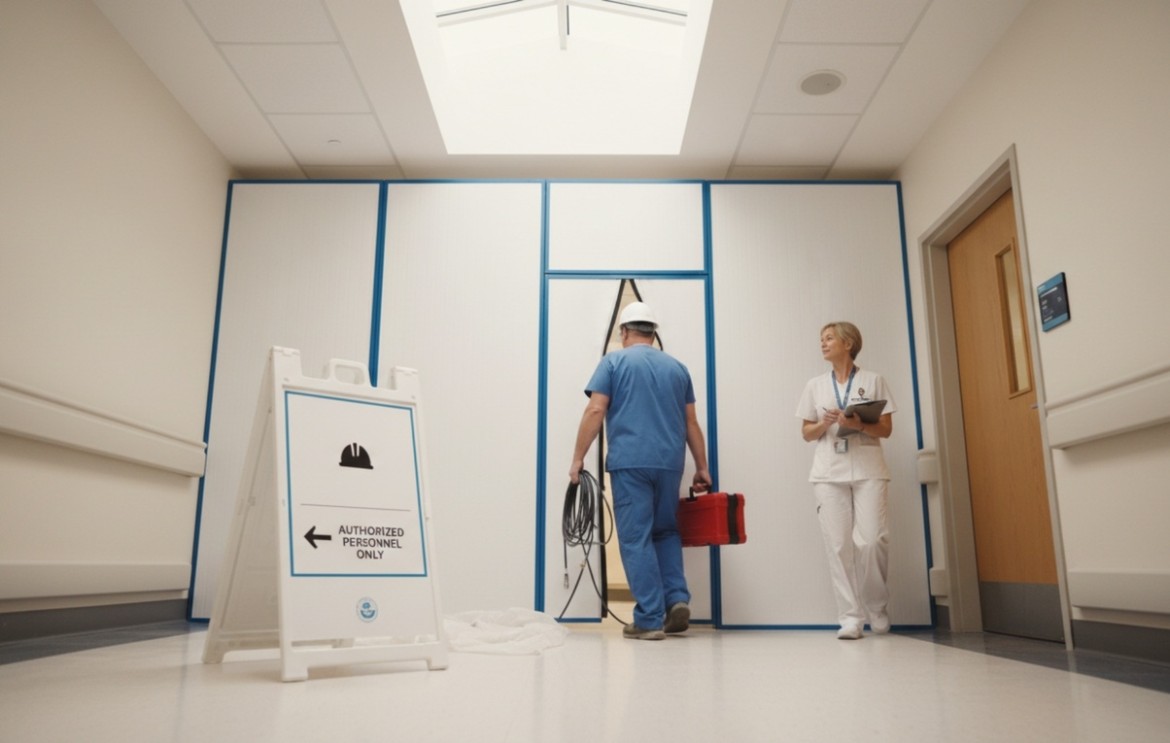
In an occupied hospital, renovation work can change egress routes, compromise fire-rated features, or require short-term shutdowns of fire alarm/sprinkler systems. Interim Life Safety Measures (ILSM) are the temporary controls that reduce risk until normal protections are restored.
Vertix Builders plans and executes occupied healthcare renovations with a focus on phasing, containment, and life-safety coordination, so your project progresses without disrupting care.
Plan and Execute ILSM for Occupied Hospital Renovations
Successful ILSM programs are simple, repeatable, and well-documented. The goal is to protect patients and staff while keeping operations predictable throughout construction.
Build Your ILSM Checklist (LS.01.02.01)
Start by confirming your facility’s ILSM policy and assessment process. The Joint Commission expects an ILSM policy that applies to construction and Life Safety Code deficiencies and includes tools to document both the assessment and the measures implemented for the duration of the deficiency.
From there, build a practical checklist of interim measures you can “turn on” based on risk. Most facilities focus on:
-
Alternate-exit signage and clear detours
-
Daily checks of exits and barriers
-
Smoke- and dust-tight partitions that meet code requirements
-
Strict housekeeping/debris control
-
Added extinguishers and hot-work controls
-
Staff/contractor education when conditions change
Control the Construction Environment
Containment is both infection prevention and life safety. Maintain tight partitions, protect penetrations, and manage airflow so dust and particulates don’t migrate into patient care areas. CDC guidance for construction/renovation in healthcare settings emphasizes containment and ventilation controls.
Operational controls matter just as much:
-
Separate public/patient traffic from construction routes.
-
Coordinate noisy or high-vibration tasks with clinical leaders (especially near NICU/ICU, imaging, or procedure areas).
-
Keep materials and waste moving on a schedule that minimizes corridor congestion.
Maintain Safe Movement and Documentation
Egress is non-negotiable. Protect required exits and keep alternate routes obvious. Mark changes at every decision point and verify accessibility during daily rounds.
Document the essentials:
-
Posted permits/plans at the work zone
-
Daily logs for barriers, exits, housekeeping, and signage
-
Impairment/restoration logs for any affected systems
-
Fire watch logs when required.
For system impairments, Joint Commission guidance commonly referenced by facilities notes documentation and action thresholds: 4 hours (cumulative) in 24 hours for fire alarm and 10 hours (cumulative) in 24 hours for sprinklers, with AHJ direction always taking priority.
Collaboration That Protects Patients and Operations
ILSM works best when operations and the jobsite run on a single playbook.
-
Hold a quick daily look-ahead with unit leaders for shutdown windows, deliveries, and disruptive work.
-
Train every worker on containment rules, emergency codes, sensitive work areas like Sterile Processing Department and Operating Room, and escalation paths.
-
Share updated detour maps and keep EVS aligned on cleaning and turnover criteria.
See more examples of Vertix’s occupied-work approach or browse the full Vertix projects portfolio.
ILSM Compliance for Healthcare Construction: Frequently Asked Questions (FAQs)
Here are quick answers to the questions that come up most during active hospital renovations.
Which standards govern ILSM in hospitals during construction?
Most hospitals align to CMS life-safety requirements (which reference NFPA codes) plus accreditation requirements (e.g., Joint Commission LS.01.02.01). Your local AHJ may add requirements and should be notified of relevant impairments.
What must be included in an ILSM policy?
At minimum: when an assessment is triggered, which interim measures may be used, and the tools you’ll use to document the assessment and ongoing implementation.
When do you need a fire watch and how should it be staffed?
Fire watch criteria and staffing are driven by your facility policy and AHJ, but many hospitals follow Joint Commission impairment thresholds (4 hours for fire alarm; 10 hours for sprinklers, cumulative in 24 hours). Staff should be trained and dedicated to the watch.
What records do surveyors expect during ILSM implementation?
Risk assessments, posted plans/permits, daily inspection logs, impairment/restoration documentation, training records, and any fire watch/hot work paperwork tied to the work.
Keep Care Continuous With a Right-Sized ILSM Program
A strong ILSM program comes down to three habits: assess risk, control the environment, and document daily. With the right routine, occupied renovations can stay compliant without disrupting care.
Planning an active-facility renovation? Explore how Vertix Builders supports life safety and infection control coordination from preconstruction through turnover.