

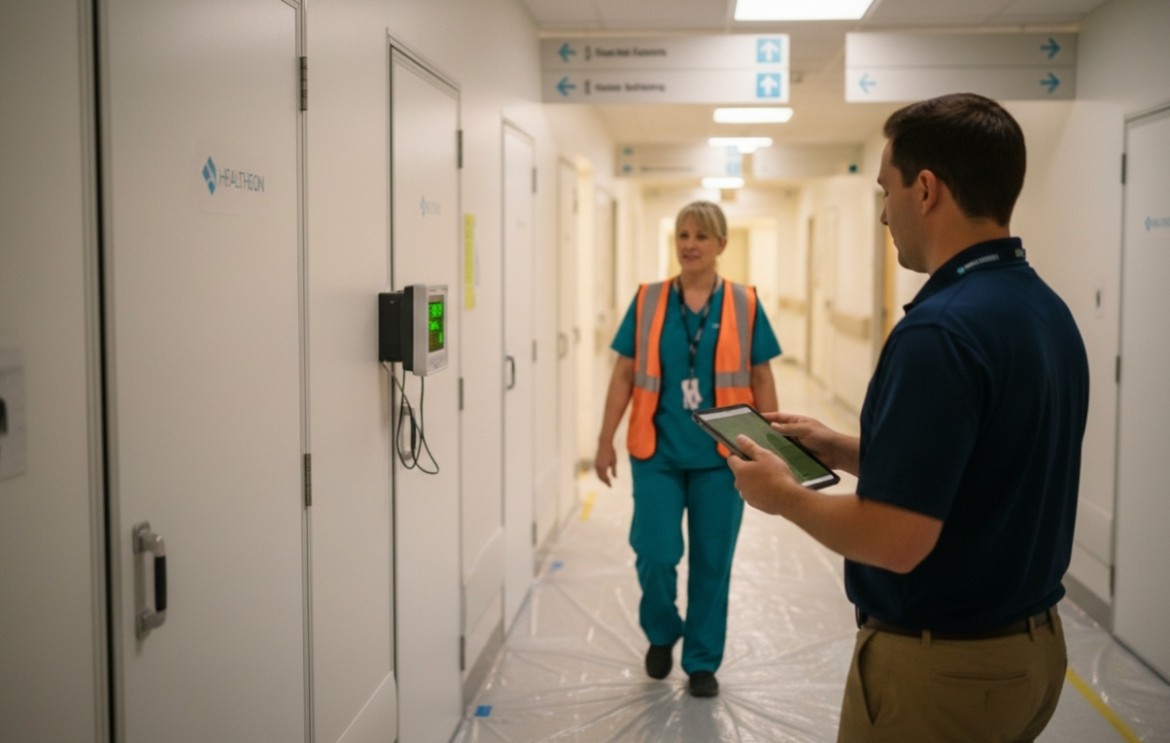
Hospitals don’t get “off hours.” The building has to evolve while patient care continues, often right next door. The projects that go smoothly are built on a documented Infection Control Risk Assessment (ICRA), measurable controls for dust and airflow, and a phasing plan that protects life safety and clinical flow.
Vertix Builders is built for this work: healthcare-focused teams and a culture that puts people and relationships first.
Plan, Isolate, and Monitor: Core Controls for Active Hospital Construction
A successful hospital renovation while operational comes down to three disciplines: (1) plan around a formal ICRA, (2) isolate the work zone so dust doesn’t travel, and (3) monitor conditions so you can correct issues fast.
Build Your Project Around the ICRA Framework
Start with the ASHE ICRA 2.0 process: Construction Type (A–D) plus Patient Risk Group determines the Class of Precautions (I–V) and whether a permit/approval is required.
For higher-risk work (often Class III–V), the matrix drives the essentials: barrier requirements, cleaning, debris handling, and negative-air needs. In Class V, ASHE calls for “critical barriers” that meet NFPA 241, sealing penetrations (including anteroom barriers), and building an anteroom for staging and cart cleaning. It also requires continuous negative pressurization and verification of HEPA performance when exhaust is directed indoors.
Replace Guesswork with Specific Performance Metrics
Two practical ways to quantify control:
Particle counts: UVA Health’s ICRA guidance targets about a 90% reduction (±10%) from an outdoor baseline (≥0.3 microns). Readings below 80% outside the barrier are a red flag that dust may be escaping.
Pressure monitoring: Use a visible monitor/manometer in the containment and log readings. ASHE recommends a device on the exterior of containment to continually monitor negative pressurization.
When you specify HEPA filtration, use the real definition: a HEPA filter is designed to capture at least 99.97% of 0.3-micron particles.
Sequence Work to Maintain Critical Systems
Phasing is where occupied hospital renovations are won or lost. Required egress and fire protection features must remain in place for occupied areas (or alternate measures must be approved by the Authority Having Jurisdiction).
Sequence work to protect: fire/smoke separations, HVAC pathways (so returns don’t pull dust into occupied space), and critical utilities (med gas, IT, power). When life safety conditions change, plan and document Interim Life Safety Measures.
Minimize Disruption Through Teamwork, Logistics, and Compliance
Occupied healthcare work is a team sport. CDC guidance supports barriers and negative-pressure enclosures for dust-generating work near patient care areas, and portable HEPA filtration when appropriate.
What reduces disruption:
A multidisciplinary core team (infection prevention, facilities, nursing leadership, EVS, security)
Weekly look-aheads tied to volumes and procedures, plus quick daily huddles
Separate clean/dirty routes and contained debris movement
Vertix Builders has done this in live environments. Our Swedish Medical Center project is one example of phasing and infection control coordination in a 24/7 setting.
Keep documentation simple: ICRA permits/approvals, barrier inspections, pressure logs, cleaning verification, and ILSM assessments (when needed) should be easy to access for internal reviews and AHJ inspections.
Operational Hospital Renovation: Frequently Asked Questions (FAQs)
These are the questions we hear most often from healthcare teams planning renovation in live clinical environments. Use the answers below as a quick checkpoint for safety, compliance, and day-to-day operations.
How do you plan for patient safety during hospital renovation while operational?
Complete an ICRA early, include infection prevention and clinical leadership, then build containment and phasing into the schedule.
What are the best practices for infection control in active hospital construction projects?
Contain dust at the source: sealed barriers, negative pressure, and HEPA filtration when required by the ICRA and facility policy.
How can hospitals minimize disruption to patient care during renovations?
Protect access routes, coordinate daily with unit leaders, and schedule shutdowns with backups and clear contingency steps.
Who should be involved in hospital renovation planning?
Occupied renovation planning should include infection prevention, facilities, nursing leadership, EVS, security, and a healthcare-experienced GC to coordinate phasing, safety, and communication
What documentation keeps you compliant during hospital construction?
ICRA permits, pressure/particle logs, barrier inspections, and ILSM assessments when life safety features are impacted.
Safer Renovations Start With Better Planning
Renovating a hospital while it stays open is high stakes. The technical pieces: ICRA 2.0, critical barriers, negative air, and monitoring, only work when the team communicates well and respects the day-to-day reality of staff and patients.
That’s the Vertix approach. Explore Vertix Builders to see how we keep safety, compliance, and operations moving in real time.